Old Dues··Updated
Old credit card dues from 4 years ago still showing
You thought the card was dead. The report still carries a balance or a charge-off. Time does not quietly delete every trade line.

The SMS landed first.
"Your overdue amount on ending 4521 is still outstanding. Pay to avoid further action."
You were not looking for a speech. You wanted someone to point at one line on the report — or at the one paper the desk actually wants — and say what it means in ordinary English.
What that message is actually saying
Old does not mean gone. Written-off, charged-off, or a forgotten small dues can sit on the file and scare a home-loan desk. Some lines age off after a bureau retention period. Some get re-aged by a collection upload. Do not guess from a WhatsApp forward about ‘7 years’. Read your PDF.
Lenders reuse short phrases because they are cheap to send. Policy norms, under review, minus applicable charges, visit branch: each one hides a list. Your job is to pull that list out of the PDF or the document packet, not to decode the officer's mood in the corridor.
If the amount is disputed — a fee you already fought in 2021 — pull those old mails before you pay. If you have no papers, a small payoff with a letter may still be cheaper than a blocked home loan. Get the letter first. Then pay. Then follow the bureau.
The one report line to read first
Open the consumer report you downloaded from the official bureau path. Ignore the decorative score ring for a minute. Find this kind of line:
Credit card · opened 2019 · status: written-off / overdue · last reported date more recent than you expected
Look at last reported date, not only opened date. If they reported last quarter, the story is alive. If the amount is small, people still ignore it. Underwriters do not ignore written-off tags as easily as you ignore ₹4,200.
Call the issuer’s official collections / care and ask for the payoff letter. Pay through official channels. Then demand an update to the bureau. Paying a random collector’s UPI without a letter is how you pay twice.
Screenshot the error. Skip the 7-day score ads
The old account block, the SMS, and any payoff letter. Match the last four digits. Scams love old card stories.
Settlement ads that promise ‘CIBIL 750 after one payment’ are selling a fantasy. Settlement can even print a settled remark, which some lenders dislike.
If a page promises a score of 800 in seven days, close it. If a stranger wants remote access to 'clean CIBIL', close that too. The official bureau site and the lender that holds the account are the two doors that count. Everything else is noise with a PAN field.
Keep the screenshots in a folder named with the date. When you visit a branch, you are not performing. You are showing two or three pictures and asking which of those pictures they used.
What to do this week
- Identify the issuer from the member name, not from the SMS alone.
- Ask for a written payoff or settlement quote on letterhead / official mail.
- Pay only to the account they specify in that letter.
- Keep the closure / update confirmation.
- Dispute if they do not update the bureau after the stated time.
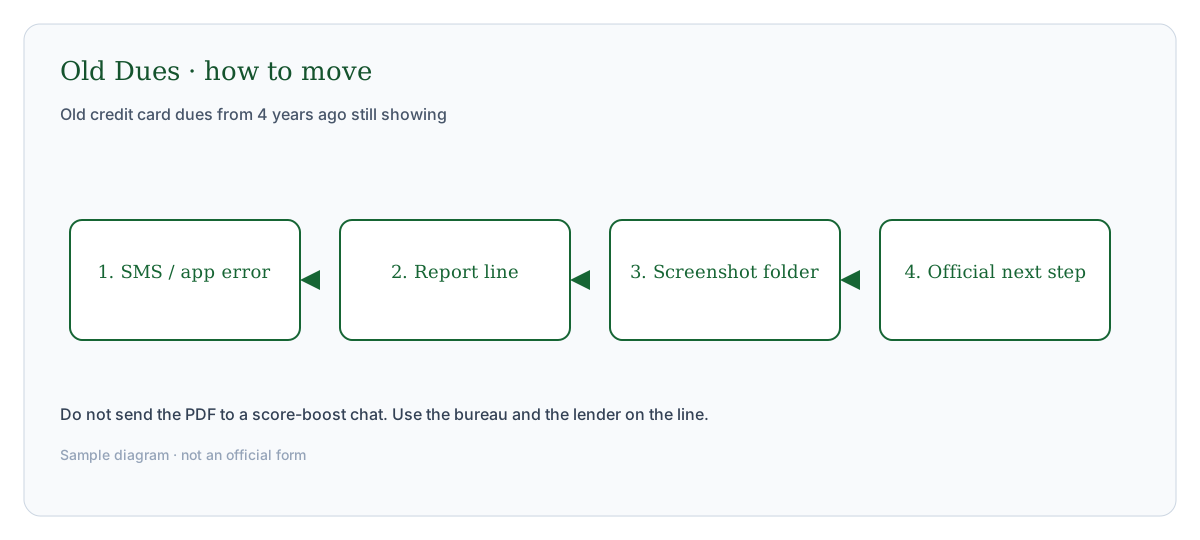
People mix a marketing SMS from a new collection agency with a genuine issuer. Always cross-check last four digits and member name. People also mix ‘sold to collection’ with ‘deleted from CIBIL’. Sale can mean a new collector, not a clean file. Another mix-up: paying and assuming overnight deletion.
Leave these ideas aside
Do not share OTP with someone who called as ‘CIBIL legal’. CIBIL does not collect card dues on a phone call like that.
A helper blog cannot sit in the dispute queue for you. It cannot call recovery. It cannot promise a sanction. It can tell you to read the line, keep the screenshot, and use the official form.
If the file is personal — a court remark, a guarantee, a joint loan after a breakup — take the PDF to the lender and, where the facts are heavy, to a qualified adviser. Do not crowd-source the next step in a comment section.
A calm way to talk at the branch
Carry the SMS, the PDF page, and one proof (payment, offer letter, KYC, valuation slip — whichever this problem needs). Ask three questions only: which line they used, which document is missing, and whether a cool-off applies before you apply again. Write the answers in your notes app. That is a better meeting than a twenty-minute speech about how decent your salary feels on WhatsApp.
If they repeat "policy norms" and nothing else, use their grievance mail with the application number. You may still get a short code. The bureau page will still be more honest than the corridor.
FAQ
Will paying a 4-year-old due raise the score fast?
It can stop the bleeding. The remark may remain for a while. Home-loan desks still ask questions.
Is settlement better than full pay?
Full pay is cleaner on many files. Settlement is a compromise with a possible settled tag. Ask what they will report.
Can they still call after years?
Collectors can still try. How you handle it is a legal and practical question. Do not take illegal ‘bachne ke tareeke’ from strangers.
Should I ignore if the SMS looks fake?
Verify on the issuer app/website. Ignoring a real due is how legal remarks grow. Ignoring a scam is wise.
Short disclaimer
Loan Atka is not a bank and not a CIBIL office. Score formulas belong to the bureau. No article can guarantee approval, a deleted enquiry, or a higher number next week. The official report and the lender letter are final for your file. For a personal case, speak to the bank or NBFC that holds the account.
Why this sits in Old Dues
This piece is filed under Old Dues because that is the shelf where the first screenshot usually belongs. You may still need a second shelf — a KYC letter as well as a bureau line, or a foreclosure quote as well as a DPD cell. Start on this shelf so you do not wander into a random 'score boost' page that has nothing to do with old credit card dues from 4 years ago still showing.
The tagline of this site is crude on purpose. If CIBIL is not opening, if a loan is rejected, if a card bill is late, check the line before you stand in the bank queue. That is the whole method. It works on this problem the same way it works on the other thirty-nine.
Loan Atka is a helper blog. The official bureau report is the one that counts. For your own file, talk to the bank or NBFC that holds the account.


