Loan Reject··Updated
Salary is decent but the bank still gave a policy reject
Take-home looks fine on WhatsApp. The engine still said no. They counted FOIR, employer category, and bureau remarks you did not mention in the chat.

The SMS landed first.
"Application declined. Policy norms. You may try after 90 days."
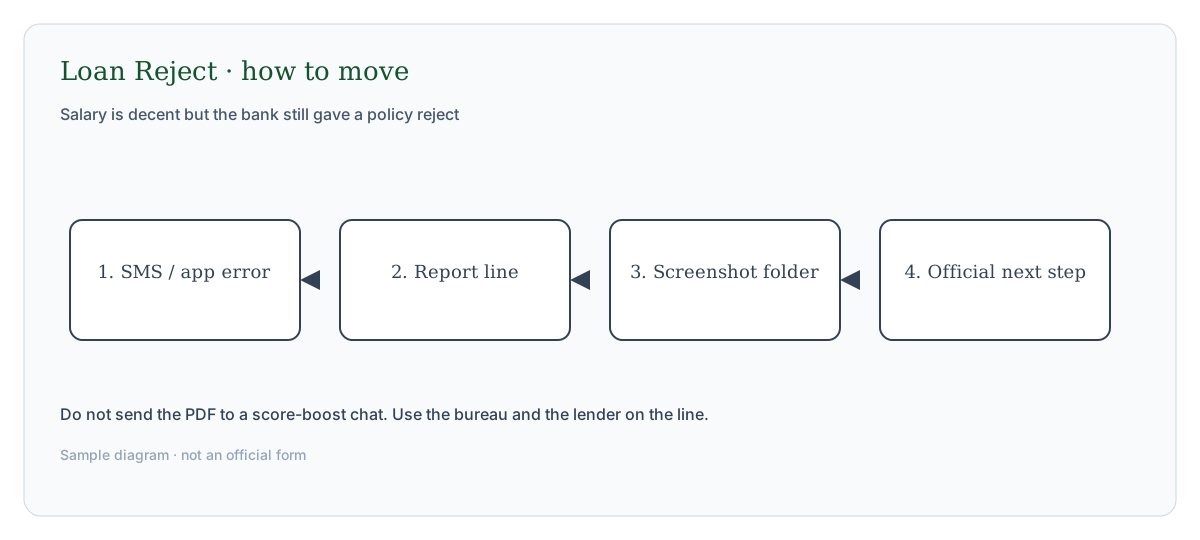
You were not looking for a speech. You wanted someone to point at one line on the report — or at the one paper the desk actually wants — and say what it means in ordinary English.
What that message is actually saying
Decent salary is not the only switch. Lenders cap how much of that salary can already be promised to EMIs. They also keep employer lists, contract-staff flags, and cash-salary flags. A 70,000 salary with 40,000 already in EMIs is not ‘decent’ to the grid. A 70,000 salary from an employer they do not underwrite can also die, even with a clean CIBIL.
Lenders reuse short phrases because they are cheap to send. Policy norms, under review, minus applicable charges, visit branch: each one hides a list. Your job is to pull that list out of the PDF or the document packet, not to decode the officer's mood in the corridor.
If the branch liked you and the central team did not, that is normal. Charm is not a policy input. Ask whether the product even allows your employer category. If they say ‘we do not do this company’, stop arguing CIBIL. Change lender or wait until your credits look like their grid.
The one report line to read first
Open the consumer report you downloaded from the official bureau path. Ignore the decorative score ring for a minute. Find this kind of line:
Open accounts · 4 · total current balance high against stated income · utilisation on card 81%
The engine added card EMIs, other personal loans, and sometimes even gold-loan instalments. High card utilisation looks like stress even if you plan to pay in full on the 5th. Policy reject with good salary is often this arithmetic, not a moral judgement on your job.
Put last three salary credits and all EMIs on one page. If EMIs eat a big slice, you found the policy. If EMIs are small, look at employer type, job months, and any bureau remark. Salary pride does not override those.
Screenshot the error. Skip the 7-day score ads
Salary slips, bank salary credits, and the bureau page of open accounts. Blur unrelated transactions if you must show a friend. Do not post slips in comment sections.
Ads that say ‘high salary loan guaranteed’ after a reject are fishing. Guarantee is not a word a honest desk uses.
If a page promises a score of 800 in seven days, close it. If a stranger wants remote access to 'clean CIBIL', close that too. The official bureau site and the lender that holds the account are the two doors that count. Everything else is noise with a PAN field.
Keep the screenshots in a folder named with the date. When you visit a branch, you are not performing. You are showing two or three pictures and asking which of those pictures they used.
What to do this week
- Calculate FOIR with every EMI, including BNPL if it reports.
- Pay cards down so utilisation is not screaming on the next pull.
- Check if your employer is on that bank’s salaried grid. A different bank may list them.
- If you are on a short contract, wait for the tenure they print in the product sheet.
- Re-apply once, not five times, after the cool-off.
People count ‘in-hand after rent’ as if rent were an EMI on the bureau. Rent usually is not on CIBIL. The engine still cares about declared obligations in some forms, but the silent killer is the reported EMIs. Another mix-up is quoting CTC. The credit shop uses credits in the bank, not the CTC slide from HR.
Leave these ideas aside
Do not inflate salary on the next form. Do not route a friend’s cash as ‘salary’ for one month. Those files get ugly when a human later opens the statement.
A helper blog cannot sit in the dispute queue for you. It cannot call recovery. It cannot promise a sanction. It can tell you to read the line, keep the screenshot, and use the official form.
If the file is personal — a court remark, a guarantee, a joint loan after a breakup — take the PDF to the lender and, where the facts are heavy, to a qualified adviser. Do not crowd-source the next step in a comment section.
A calm way to talk at the branch
Carry the SMS, the PDF page, and one proof (payment, offer letter, KYC, valuation slip — whichever this problem needs). Ask three questions only: which line they used, which document is missing, and whether a cool-off applies before you apply again. Write the answers in your notes app. That is a better meeting than a twenty-minute speech about how decent your salary feels on WhatsApp.
If they repeat "policy norms" and nothing else, use their grievance mail with the application number. You may still get a short code. The bureau page will still be more honest than the corridor.
FAQ
What FOIR do banks want?
It differs by product and by shop. Treat a high existing EMI stack as a problem even if nobody quotes a number to you.
Will a salary hike next month fix this?
After it shows as credits, maybe. A promise on a chat is not a credit.
Does a government job always pass?
It helps on some grids. Overdue on the bureau can still stop the file.
Should I close a small loan before re-applying?
If the closure is cheap and the FOIR is the issue, it can help. Check foreclosure charges first.
Short disclaimer
Loan Atka is not a bank and not a CIBIL office. Score formulas belong to the bureau. No article can guarantee approval, a deleted enquiry, or a higher number next week. The official report and the lender letter are final for your file. For a personal case, speak to the bank or NBFC that holds the account.
Loan Atka is a helper blog. The official bureau report is the one that counts. For your own file, talk to the bank or NBFC that holds the account.


